Pape: Stunning US Squeaks Out of Strategic Defeat


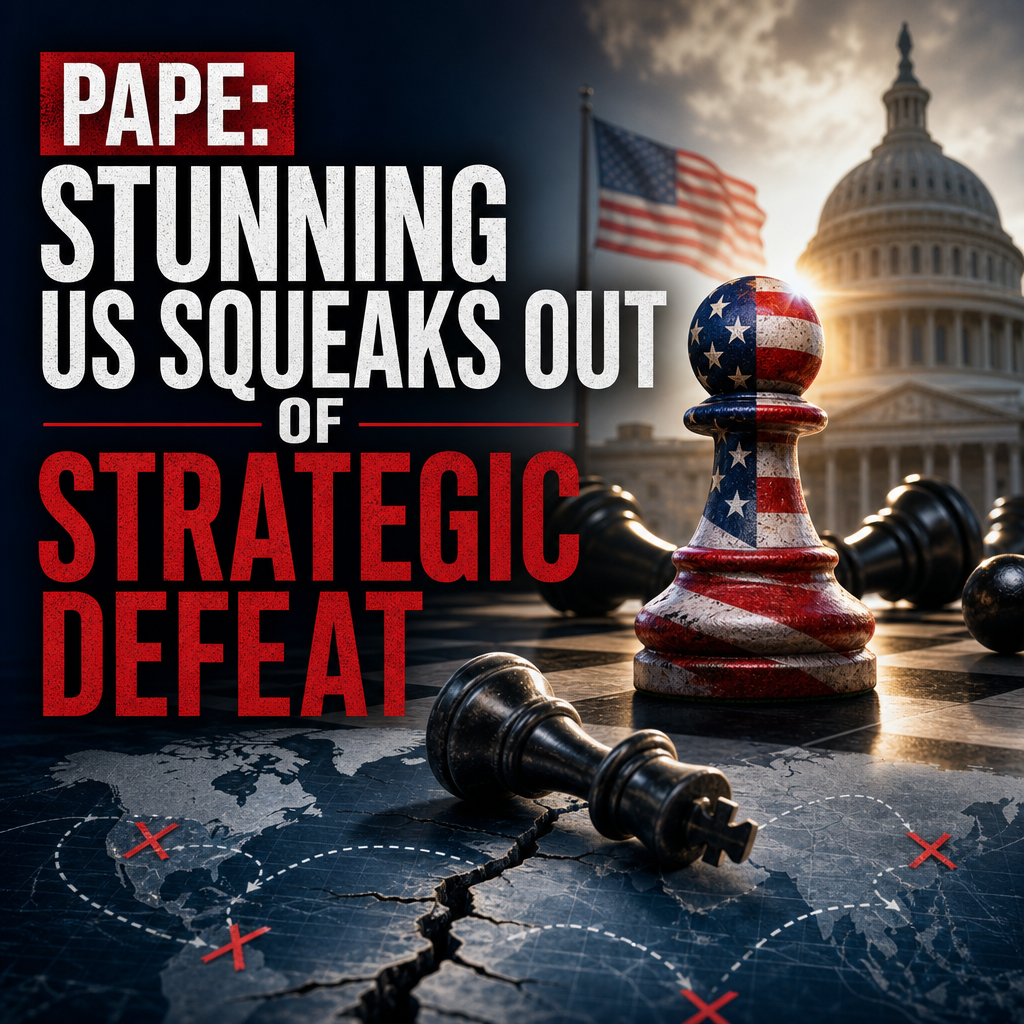
Pape argues that the United States is trying to “squeak out” of what could still become a strategic defeat, and that warning captures the uneasy debate now surrounding Washington’s posture toward Iran, Israel, and the wider Middle East.
At the center of the discussion is a simple but uncomfortable question: even when the US can claim tactical gains, is it actually achieving its larger political goals? Across the reporting and commentary landscape, there is no single answer. Some assessments emphasize deterrence and damage limitation. Others point to a pattern that looks less like success than managed retreat. And a third view, often overlooked, suggests the reality may be messier: Washington may be preventing a worse outcome without securing a durable win.



What “strategic defeat” means in practice
When analysts talk about strategic defeat, they are usually not talking about a battlefield collapse. They mean something broader: a failure to shape events in a way that leaves the US, its allies, and the regional order more secure over time.
That is why Pape’s framing matters. It suggests the US can look effective in the short term—through military force, alliance support, sanctions, or diplomacy—while still losing ground strategically. If an intervention, retaliation, or show of force does not change the underlying balance, it may only delay the next crisis.




This interpretation has obvious appeal to critics of US policy in the Middle East. From that perspective, Washington often gets drawn into conflicts where its objectives are too vague, its red lines too fluid, and its willingness to pay the long-term political cost too limited. In that sense, the phrase “squeak out” implies not victory, but survival.
Yet that is not the only reading. Supporters of a tougher US line would argue that strategic success in a volatile region is often measured by what does not happen: a wider war, a collapse of deterrence, or an uncontrolled escalation. If Washington can prevent those outcomes, even at the price of appearing cautious or inconsistent, it may still be acting rationally.
Pape’s warning and the case for caution
Pape’s warning resonates because it challenges the most optimistic version of US power: the idea that American pressure automatically produces political leverage. In reality, the Middle East has repeatedly shown that force can be highly visible without being decisive.
Several patterns stand out:
– Tactical action does not guarantee strategic control. A strike, a deployment, or a diplomatic ultimatum may create a moment of pressure, but not necessarily a long-term shift in behavior.
– Allies do not always share the same endgame. The US, Israel, and regional partners may agree on the need to contain threats, but disagree on how far escalation should go.
– Adversaries often absorb pain differently. States like Iran have historically used endurance, dispersion, and proxy networks to reduce the effect of direct pressure.
– Domestic politics matter. American leaders often face a gap between what military planners recommend and what voters will tolerate after years of war fatigue.
That does not mean the US is powerless. It means power is expensive to convert into results. The concern in Pape’s argument is that Washington may be mistaking temporary stability for durable influence.
Different news lenses, same unresolved dilemma
The value of looking across multiple news sources is that the same event can look very different depending on the angle.
Al Jazeera’s coverage and commentary often foregrounds the human and political costs of confrontation, especially for civilians and for regional stability. From that perspective, Washington’s actions can appear reactive, overly aligned with military escalation, and insufficiently attentive to the broader consequences for the Middle East.
RT-style framing typically places far more emphasis on US overreach and the limits of Western power. That lens is usually skeptical of American claims of restraint or success, and more likely to describe US moves as evidence of decline, contradiction, or strategic confusion.
Sky News, by contrast, tends to reflect a mainstream Western policy debate: concern about escalation, but also concern about appearing weak. That makes its coverage useful for understanding the dilemma faced by US officials—how to avoid a larger war without inviting the impression that deterrence no longer works.
Taken together, those viewpoints do not produce a neat consensus. They do, however, highlight a shared uncertainty: the US may be able to manage the crisis, but management is not the same thing as resolution.
The uncomfortable middle ground
The most credible conclusion may be the least dramatic one. The US is neither collapsing nor clearly prevailing. It is trying to preserve deterrence, protect allies, and avoid escalation while operating in a region where every move carries second-order consequences.
That leaves policy in a fragile middle ground:
– Too much force can widen the conflict.
– Too little force can embolden rivals.
– Diplomatic restraint can look like weakness.
– Military confidence can look like escalation.
This is exactly why the “strategic defeat” argument has traction. It does not require proving that the US has already lost. It only requires showing that Washington may be failing to convert immense power into the kind of political order it wants.
A fair reading: not defeat, but no clean victory
The most balanced view is that the US is in a contested, uncertain position. It still has enormous military reach, deep alliances, and the ability to shape events. But those assets no longer translate automatically into strategic success, especially in a region where local actors can absorb pressure, reinterpret US signals, and exploit divisions among American partners.
So the question is not whether the US can act. It clearly can. The question is whether it can act in a way that produces a stable outcome rather than simply postponing the next crisis.
That is why Pape’s warning is worth taking seriously. It is less a declaration of defeat than a caution against confusion: confusing motion with momentum, restraint with control, and short-term tactical gains with a lasting strategic result.